
Most personas are a waste of time
Almost all personas are useless and it’s tragic, really, because when they’re done well, personas are genuinely useful. They’re a fantastic tool for building understanding and give a team something concrete to test ideas against. They bridge the gap between research and design. The problem is almost always how we frame them.
Every designer has a story like this one. Your team has spent weeks creating a persona deck. Names, stock photos, favourite coffee orders and a quote pinned at the bottom that reads like a cheesy greeting card. It gets presented once, everyone’s relieved it’s done and then it disappears into a SharePoint folder, never to see the light of day again.
It’s tragic really because when they’re done well personas are genuinely useful. They’re a fantastic tool for building understanding and give a team something concrete to test ideas against. They bridge the gap between research and design. The problem is almost always how we frame them.
Personas are not a final product
The biggest mistake I see is organisations treating a persona as a deliverable, something you produce to prove the research happened. But they’re not meant to be a deliverable, they’re supposed to be a tool for making decisions, a means to an end. If they’re not showing up in ideation or prototype testing they aren't doing their job.
So instead of starting with "What should our personas look like?" It's worth starting with "What customer behaviours do we need to consider when making design choices?" That one shift in framing changes almost everything downstream. What you prioritise, what you include and what you leave out.
Context tells you why
People don't make decisions in isolation. We're shaped by family, community, culture, work, and a hundred small social expectations we barely notice. So it's strange how often personas flatten all of that into a checklist. We include details like: shops online, uses social media, cares about sustainability, time-poor. None of that is wrong, it's just not very useful on its own, because it tells you what someone does without ever getting at why.
Take two people furnishing their first home. Both in their early twenties, both renting, both on a tight budget. On paper they’re identical. But one just left home for university and the other moved cities for a work apprenticeship. Their support networks are different. Their financial pressures are different. What they're optimising for is different. Age put them in the same bucket but their context is what actually explains their choices and that’s what we as designers must consider. A persona shouldn’t be demographic checkbox.
Arbitrary information leads to biases
The hardest part of building a persona usually isn't deciding what to include, it's having the discipline to leave things out. Every detail you add signals importance, whether you mean it to or not. Mention someone's age, gender, ethnicity or occupation, and people will quietly assume it explains their behaviour. Sometimes it does. Often it's just noise dressed up as insight. And in the worst cases it’s an unchecked cliché.
If a characteristic doesn't change the design decision in front of you, cut it. But if you do include it, say why it matters. If a persona states someone's ethnicity or gender without explaining its relevance, you're not giving the team information; you're handing them a blank space to fill in with their own assumptions. And those assumptions are exactly how personas end up reinforcing stereotypes instead of preventing them.
A leaner persona reduces bias rather than baking it in.
They're not for your customers
One habit worth breaking is showing personas to the customers they're based on. Some businesses like doing this, usually to demonstrate how well they "get" their audience. I’ve seen them published on websites and handed out at co-design workshops.
But your customers already know themselves, they're not going to find much value in a summary of who they are. And I’d argue in some cases they probably won’t like being pidgeon-holed. What they actually care about is the thing your persona was supposed to produce: a design that works for them.
If a persona never leaves the building, that's fine. Its job was always internal.
Personas should call out differences
There's a failure mode that's easy to miss because it only shows up once you have more than one persona in the room. You end up with, say, four of them, and on paper they're distinct. Different names, different photos, different quotes. But look closer and they're all saying some version of the same thing. One cares about things being "ethically sourced," another is motivated to live "ethically". Different words, same idea, no real contrast between them.
This matters more than it sounds like it should. If your personas overlap this much, two things tend to happen. People using them can't see themselves as clearly fitting any single one; they feel like a bit of all four, which makes the whole set less useful for understanding their customers. And designers lose the ability to test an idea against genuinely different needs, because the "different" personas would all react to it the same way anyway.
Good personas are personas that call out customers' different motivations and behaviours. If two of them could be merged without losing anything, they're one persona, not two.
Build them from real people
A persona is a synthesis of research, not a creative writing exercise. That means actual time with real customers. Watching how they behave and noticing what’s important to them.
The payoff is twofold. Designers connect far more easily with a person who feels real than one who was clearly invented in a workshop. And personas grounded in real behaviour hold up better as a foundation for generating and testing ideas, because they're describing an actual problem rather than a plausible-sounding one.
A quick test for whether yours is any good
Here's a simple gut check: hand the persona to two designers and ask them, separately, what problem they think they're solving. Not what they'd design, their solutions can and should differ, that's the point of having designers. What matters is whether they'd describe the problem that needs to be solved the same way.
A good persona makes the problem unambiguous, even if it leaves plenty of room for different answers to it. If two designers walk away with two different ideas of what they're actually fixing, the persona hasn't done its job, no matter how good either of their designs turn out to be.
The best personas aren’t remembered for the illustration style or the layout. They're remembered because people kept reaching for them, because they helped a team challenge an assumption, understand a bit more context, or make a call they were otherwise stuck on. That's all a persona needs to do.

Designed to not fail
Real strategy makes a specific, contestable claim about what exactly needs to change to improve the way things currently are. And for that reason, real strategy is often polarising. If everyone agrees with your strategy, you probably don’t have one.
If you work corporate, at some point you’ll probably be handed a strategy document. It might be the first week you start a new job, or perhaps you’ve been around long enough to have written a few yourself.
Whatever your experience, there's a good chance that when you read it you had this thought: “I haven’t got a clue what this is telling me to do.”
The document is long and has been signed off by important people. It’s got a vision statement. Clear problem diagnosis. Pillars of change. Timelines of projected deliverables. Values. There’s a ton of information that you theoretically understand. You must be missing something.
Maybe I’m a little slow, but it took me a while to work this one out. You’re not missing anything. The document isn’t telling you what to do because it is not designed to give direction, it’s designed not to fail.
And if our systems are designed not to fail, are they also designed not to succeed?
Why strategy sounds like strategy but it isn’t
Most strategy documents I’ve seen are written to get approval.
In large organisations, particularly government, putting a strategy together is a way to justify spend and convince decision-makers to sign off. They probably started with a template that asked questions like: What’s the problem that needs to be fixed? Why is it worth public money? What are the risks? Who is accountable?
People who write these strategies are skilled at getting permission. The goal has little to do with how change will actually happen, which is what a real strategy should do.
By the time a clear strategy has survived review and consultation, all the sharp edges have been sanded down, the definitive language has been replaced by corporate speak, specific beliefs have been broadened out to safe data points. And you end up with something that nobody important can object to.
And so mission statements become vague, politically sanitised goals. Things like improve mental health, reduce unemployment, increase exports, be more digital.
Real strategy makes a specific, contestable claim about what exactly needs to change to improve the way things currently are. And for that reason, real strategy is often polarising. If everyone agrees with your strategy, you probably don’t have one.
What real strategy looks like
In 2001, Portugal decriminalised drug use. I don’t know what the approval process was for that strategy, but somehow it got legislated. The belief at the centre of it was that addiction is a health issue, not a criminal one. The strategy is anchored on the theory that criminalisation doesn’t reduce drug use, it only pushes people into hiding.
This strategy did something that most strategies don’t do, it clearly defined what the organisation believes is causing the problem. The mission statement wasn’t ‘reduce drug use’. The organisation believed removing stigma and punishment would lead to better outcomes. They stuck with it through all the critique and saw results.
Southwest Airlines did something similar when they transformed their business model. They made a bet that customers care more about cheap flights than comfort. Again, their strategic belief was very clear, that many customers are looking to save money, not have the best experience.
They stripped everything back, from aircraft types to meals and seats, and they too faced immediate backlash. Reports predicted it would tank their business, but instead it transformed how the whole industry operated.
Neither of these strategies were put together by filling in a template or using another organisation’s strategy as a blueprint. The only reason they existed was because someone brave in a leadership position took a new perspective on an old problem and ran with it.
Our systems are designed to keep the status quo
So if you’re new to all this and you’re wondering why you can’t make heads or tails of a strategy document, that’s why. And if you’re an old hand, you may be feeling a flicker of recognition.
Strategy language is designed to satisfy reviews and appease upwards. It is designed to reward agreement and minimise risk, which is why intelligent people keep producing underwhelming outcomes.
And while alignment and risk management are important, what you’re often trading away is the possibility of anything getting better. You are sacrificing growth for the comfort of an establishment that is scared to rock the boat, not least because those who suffer most from broken systems are rarely the people who control them.
A brave leader decides they understand something important about how the world works, and they organise people and resources around that belief. Then they have to live with the consequences long enough to discover whether they were right. Anything else is just organisational maintenance.

Things I’ve learnt talking to strangers
When I was 23, I thought the hard bit was getting strangers to talk. After thousands of interviews, I realise the opposite is true. The hard part is getting someone to listen.
When I was 23, I scored a one-week work experience placement at my local paper in Brighton, UK.
The first job my editor gave me was conducting a vox pop. If you’re not sure what that is, in design language it is similar to intercept interviews. You stand in a public space with a clipboard, you stop a stranger walking down the street, and you ask them a bunch of questions on a specific topic.
Well, anyway, my editor told me to stand outside Asda (a giant, very busy supermarket across the road from our office) and ask shoppers for an interview.
She gave me the following instructions: I must interview 7 women and 3 men. I must get down their full name, age and occupation. I must take a clear photo of their face. And the topic she wanted me to get their opinion on was:
‘What do you think about men wearing leggings?’
My face must have gone white with horror I guess, because my editor patted me on the shoulder and said softly, 'Just give it a go.' And so I did.
Two hours later, I strolled back into the office with a notebook full of quirky opinions, and guess what? I loved it.
Don’t get me wrong, I was terrified at the prospect of stopping busy people and asking them silly questions. I’d never considered myself a conversationalist, particularly. But this experience opened my eyes to a completely new way of connecting with people.
Standing with my daft clipboard asking my even dafter questions about leggings, I was astounded by how freely people gave me their opinions and life stories. How such a trite question led people to spend their time with me in a supermarket car park talking about their family members and celebrity crushes and everything else.
It was joyous. Getting a glimpse into a stranger's life, laughing at their stories, thanking them while they posed for a photo.
I felt like I’d stumbled on some sort of magic key.
And I suppose it sort of is magic, if you don’t know this one little secret rule for talking to other humans: everyone loves telling their stories to people who are interested in listening to them.
When I was 23, I thought the hard bit was getting strangers to talk. After hundreds of interviews, I know the opposite is true. The hard part is being someone who wants to listen.
Most people are carrying around stories that nobody has ever thought to ask them about.
And that is how you can talk to virtually anyone.
I still have a copy of that Vox Pop. The first time I saw my name in print.
Twenty years later, it sits in a ring binder on my shelf as a reminder that most people are far more interesting and willing to talk than we give them credit for.
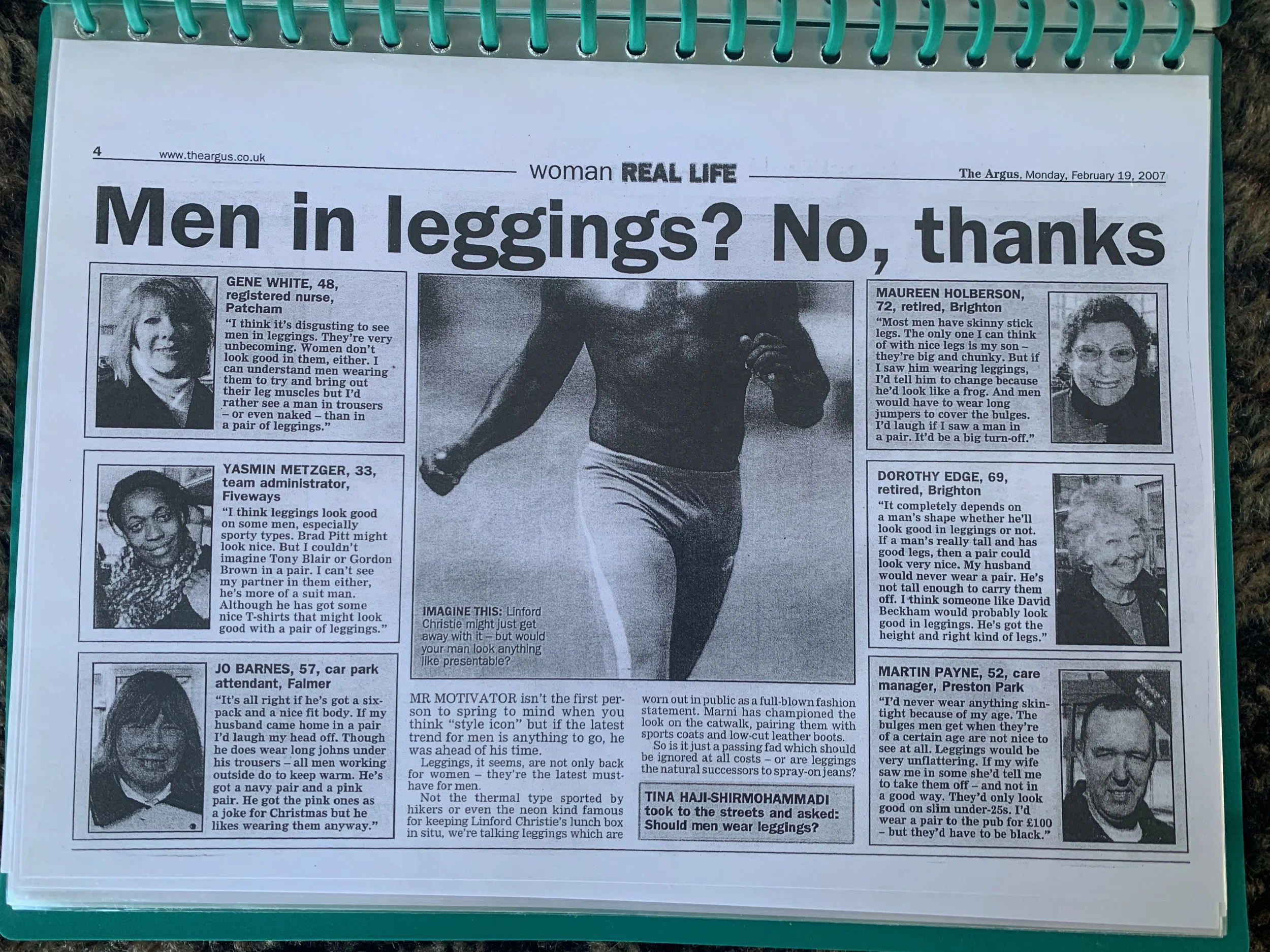
Excerpt from The Argus newspaper

A designer’s guide on how to write good
If you’re ready to level up your writing game and stop torturing your readers, I’ve got a few simple tricks to help you turn that dry, jargon-filled sludge into sharp, engaging stories people will actually want to read.
As a failed journalist, I know a thing or two about bad writing.
Fresh out of university, degree in hand and confidence sky-high, I was convinced I had elite writing skills. After all, my professors loved my essay writing, laden with flowery flourishes, long-winded arguments and references to obscure social theories.
Then came my first job at a local newspaper. It didn’t take long to realise I had a problem.
My editor, unimpressed by my intellectual gymnastics, emailed me back a brutal reply to my first draft with a single comment: “Sorry Tina, but this is unreadable.”
It was a hard fall from academic grace, but also the best thing that happened to my writing. That one savage line forced me to unlearn the very habits I’d spent three years perfecting. I had to strip away the fluff, ditch the jargon, and start writing like a regular Joe.
And dear reader, I’m sorry to tell you this, but if you haven’t taken a similar fall, chances are your writing could use a little de-academising too.
Your emails, documents, LinkedIn posts, maybe even your texts, there’s a good chance they’re bogged down with unnecessary words, over-complicated language and the kind of corporate jargon that puts everyone straight to sleep.
So, if you’re ready to level up your writing game and stop torturing your readers, I’ve got a few simple tricks to help you turn that dry, jargon-filled sludge into sharp, engaging stories people will actually want to read.
Trick 1: Do some planning
A lot of us treat writing like a process of discovery. But that usually makes for terrible reading material. Good writing can take messy thinking and make it legible to someone else.
My daughter was taught this in primary school through a simple structure. Before she wrote a single sentence, her teacher gave a four-box template to fill in that looked something like this:
How does the story begin?
What is the conflict?
How does it resolve?
How do things end?
And this is, basically, exactly how the best writers in the world work.
Take a look at J.K. Rowling’s handwritten outline for Harry Potter and the Philosopher’s Stone. It's a carefully crafted table filled with chapter-by-chapter breakdowns, plot points, subplots, character arcs. Before she wrote the wizarding world into existence, she had a roadmap.
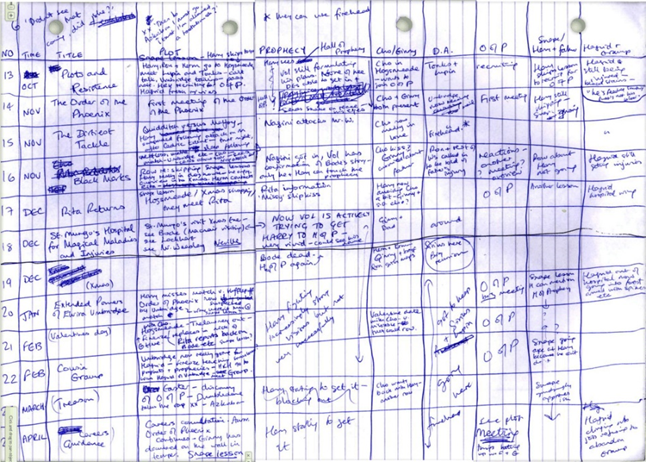
Story plan for Harry Potter and the Philosopher’s Stone
If the most successful authors on the planet are planning their writing in detail, what makes you think you can just wing it?
Planning what you want to say before you start writing helps you focus on what actually matters and ensures your message unfolds in a way that your readers can follow and understand. In professional environments this is a step that is often skipped, and it usually results in documents that are unnecessarily long, unfocused and hard to use.
So before you open that blank Word doc and start typing whatever comes to mind, pause. Sketch out a plan. Even a quick bullet-point outline will do.
Your thoughts will be clearer. Your writing will be stronger. And your weary readers will thank you for it.
Trick 2: Dumb it down
Hands up if you’ve ever received a message, started reading it, couldn’t focus, so thought to yourself ‘I’ll read that properly later’.
Now keep your hand up if you forgot to read it properly later.
Yup, we’ve all been there, and there’s a good reason why. Processing someone else’s thoughts takes mental effort, especially when your brain is already preoccupied. Shifting cognitive gears costs time, energy, and focus.
In other words, the more impressive and sophistocated your language is, the more likely it is to be ignored. Because sure, you might sound clever using academic language, but it makes it far less likely your readers will have time to understand what you’re trying to tell them.
Research into reading behaviour backs this up. Studies show that the more advanced the writing level, the more readers tend to stop and re-read, trying to make sense of sentences. And it’s blocking communication.
The average adult in New Zealand reads comfortably at a 12-year-old level. And it’s got nothing to do with intelligence, it speak to how we process language under the pressure of everyday life. We read faster, understand more and remember messages better when the words are simple.
Most writing is consumed in fragments. Between meetings, emails on phone screens, while multitasking. Complexity creates friction, and busy people have less time to understand complex ideas.
So, if your writing wouldn’t make sense to a 12-year-old, you might want to ask yourself: ‘Who am I really writing for?’
If your goal is to connect, inform, or get a quick reply, your best bet is to keep your language basic.
Your message might be brilliant, but if no one has the energy to read it, what's the point?
Trick 3: Kill your Darlings
Mark Twain once wrote, “I didn't have time to write a short letter, so I wrote a long one instead.”
He understood that clear writing takes effort and most first drafts are bloated with unnecessary details and confusing, fluffy language.
“Kill your darlings” is a writer's term that means cutting even the parts of your writing you love if they don’t serve the message well. The same principle applies when you want your message to land.
The discipline of editing is not about making writing shorter for its own sake. It is about removing everything that does not serve comprehension. That often includes the parts we are most proud of.
There is a reason experienced editors cut aggressively. It is out of respect for the reader’s time and attention.
A useful rule is this: if a sentence exists to demonstrate intelligence rather than advance meaning, it is in the way.
Editing takes time and effort, but it’s the greatest kindness you can show your reader.
And that’s it, I reckon. The three tricks that will instantly improve your writing: plan it, simplify language, and once you’ve written it all out - cut it back as much as possible.

How to find a problem
The question to ask ourselves is simple but crucial: What’s the best problem we can solve?
The way we frame a problem can make or break the entire project. It’s the blueprint for everything that comes after. The question to ask ourselves is simple but crucial: What’s the best problem we can solve?
Too often, design teams jump straight into the weeds of discovery without truly understanding the problem at hand. We assume we know what the customer needs, and in doing so, risk solving the wrong problem. The key to success is taking the time to diagnose the problem upfront, which ensures we’re not chasing symptoms but addressing the root cause.
Take this example: “I need a new car, but I can’t afford it.”
At first glance, the problem seems obvious, the customer needs a car, but money is a barrier. This framing makes it feel easy to jump to familiar solutions. Find lower-cost vehicles, explore financing options or savings plans. But this kind of immediate solutioning assumes the problem has already been correctly defined.
A more careful approach is to resist that first framing and expand the inquiry before narrowing it again. This means stepping back into lived experience and understanding the context that produced the statement in the first place.
To do this, we must move beyond surface-level questions and dig into the bigger picture. Consider these two probing questions:
“Tell me about a time you didn’t use your car to meet your needs." By asking about lived experiences, we can uncover deeper insights. Maybe the customer takes public transport when the weather is good, or walks if they have the time. We understand how people navigate constraints and hint at broader system failures.
“Why do you need a car?” This question is deceptively simple, but it begins to surface intent rather than solution. A response like “I need to get to work and drop my kids off” reframes the issue entirely. The problem is no longer about vehicle ownership; it becomes about reliable access to employment, education and caregiving responsibilities within time and geographic constraints.
From these conversations, we might reframe the problem entirely. What seemed like a straightforward case of “I need a car” becomes a more complex but accurate statement. Perhaps something like “I need a safe, reliable and affordable way to take my kids to school and get to work.”
This new problem statement opens the door to a wider array of solutions and encourages creative thinking. Perhaps alternatives to car ownership, or novel ways to maximise time and resources we may not have considered otherwise.
For designers and researchers working in complex systems, the discipline is not simply to “find the right problem,” but to stay with ambiguity long enough to understand how that problem has been constructed in the first place, and whether it is the right one to solve at all.
The most important work often happens before the problem feels clear.
For more on this, check out the HBR article Are You Solving the Right Problems by Thomas Wedell-Wedellsborg

Building rapport: the do’s to not do
It All Begins Here
For human-centred designers, there are clear do’s when it comes to connecting with participants. You know the sort of thing I’m talking about: be curious, be patient, be authentic.
But I’ve also learnt some things the hard way. The thing that no one during my design training told me is there's also a 'don'ts' list of things to avoid doing. The things on this list are not as obvious.
To save you from experiencing the same awkward times I have, here's a refined list of some unlikely things I advise you to stop doing right away. You're welcome in advance:
Don’t Be Relatable
This is counterintuitive, but hear me out.
I once interviewed a stay-at-home mum whose children were the same age as mine. Wanting to build rapport, I mentioned I was also a mother and shared some of my struggles with balancing work and daycare. Nice bit of mum-bonding, right? Well, no.
Instead, it did the opposite. She became noticeably more careful in how she described her own choices, particularly around not working outside the home. When I asked her questions about her decision to stop working, she looked uncomfortable and said she didn’t want to offend me by telling me she quit her job to raise her children. She worried I might feel she was judging me for being a working mum.
She was navigating just the conversation in order to not hurt my feelings, which made for a much less open and honest interview. And that wouldn’t have happened if I hadn’t given her insights into my lifestyle.
People are already making judgements about you based on how you look, sound and interact. Don’t add to that by over-sharing personal details. These days, I tend to not share anything about my own life in interviews.
Building rapport isn’t building connection; it’s about creating conditions where participants feel safe to talk freely. Not making friends.
Don’t Have Values
I’m being a little facetious here, because of course it’s not possible to remove your moral values from your research. But it is vital that you don’t let them influence how you respond to participants in the moment. It doesn’t matter if they’re sharing something you feel is positive or negative, you must remain neutral.
I once spoke with a teenager at length about joyriding cars, something that in any other context I would have probably flagged as dangerous and harmful. Because I stayed non-judgemental, he talked openly about what that behaviour represented in his world. I got a rare glimpse into his context and motivation, which entirely changed how I understood him.
Dig deeper into motivations without giving away your moral values because once your values enter the conversation, it narrows what people are willing to share.
Your job is to understand, not judge.
Don’t Hold Eye Contact
This goes against all the advice on building rapport you will ever come across, but it’s a hill I’m prepared to die on. Prolonged eye contact is awkward. It often makes people feel rushed or intimidated, it leaves little room for natural pauses or thinking time, it makes participants feel observed rather than heard.
And if you’re cursed with an expressive face like me, you run the risk of influencing your participants by reading into your facial expressions and biasing your findings.
Over time, I’ve moved away from maintaining constant eye contact, and I have a few tricks I use to do this.
I focus my eyes on something else, usually a prop I bring with me. Like a paper (not electronic) notebook to write notes in, and only make eye contact briefly when asking questions or showing that I’m focused.
During ideation or prototype testing, I like standing side by side with participants, so we’re not forced into ongoing direct eye contact, making the experience feel more comfortable and collaborative. Some of my favourite interviews have happened while driving a car or going for a walk. That way, things feel more like a shared activity instead of an interrogation.
Don’t Be Helpful (At Least Not Immediately)
When participants struggle with something you know a lot about, resist the urge to jump in and help.
It’s tempting to offer your expertise because we want to be helpful. It feels efficient and kind. But your goal as a researcher is to understand their struggle, not fix it right away. If you solve their problem too quickly, you lose the opportunity to learn what’s really behind their challenges and won’t fully understand where the friction actually is.
Instead, focus on uncovering the reasons they’re struggling and how you can help reduce that struggle down the line. What are the assumptions, constrains or workarounds they’re using that shape their experience?
As well as it being good design practice, it’s also good conversation etiquette to hear someone explain their problem before offering solutions.
Moments of struggle and confusion are important data points, they’re not interruptions.
So there you have it. Four odd little tips to help you have less awkward and more honest interactions in work and life. Use as needed, responsibly.