As a failed journalist, I know a thing or two about bad writing.
Fresh out of university, degree in hand and confidence sky-high, I was convinced I had elite writing skills. After all, my professors loved my essay writing, laden with flowery flourishes, long-winded arguments and references to obscure social theories.
Then came my first job at a local newspaper. It didn’t take long to realise I had a problem.
My editor, unimpressed by my intellectual gymnastics, emailed me back a brutal reply to my first draft with a single comment: “Sorry Tina, but this is unreadable.”
It was a hard fall from academic grace, but also the best thing that happened to my writing. That one savage line forced me to unlearn the very habits I’d spent three years perfecting. I had to strip away the fluff, ditch the jargon, and start writing like a regular Joe.
And dear reader, I’m sorry to tell you this, but if you haven’t taken a similar fall, chances are your writing could use a little de-academising too.
Your emails, documents, LinkedIn posts, maybe even your texts, there’s a good chance they’re bogged down with unnecessary words, over-complicated language and the kind of corporate jargon that puts everyone straight to sleep.
So, if you’re ready to level up your writing game and stop torturing your readers, I’ve got a few simple tricks to help you turn that dry, jargon-filled sludge into sharp, engaging stories people will actually want to read.
Trick 1: Do some planning
A lot of us treat writing like a process of discovery. But that usually makes for terrible reading material. Good writing can take messy thinking and make it legible to someone else.
My daughter was taught this in primary school through a simple structure. Before she wrote a single sentence, her teacher gave a four-box template to fill in that looked something like this:
How does the story begin?
What is the conflict?
How does it resolve?
How do things end?
And this is, basically, exactly how the best writers in the world work.
Take a look at J.K. Rowling’s handwritten outline for Harry Potter and the Philosopher’s Stone. It's a carefully crafted table filled with chapter-by-chapter breakdowns, plot points, subplots, character arcs. Before she wrote the wizarding world into existence, she had a roadmap.
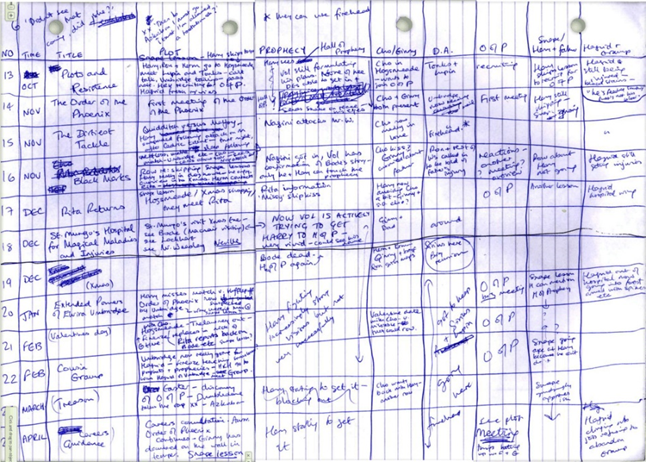
Story plan for Harry Potter and the Philosopher’s Stone
If the most successful authors on the planet are planning their writing in detail, what makes you think you can just wing it?
Planning what you want to say before you start writing helps you focus on what actually matters and ensures your message unfolds in a way that your readers can follow and understand. In professional environments this is a step that is often skipped, and it usually results in documents that are unnecessarily long, unfocused and hard to use.
So before you open that blank Word doc and start typing whatever comes to mind, pause. Sketch out a plan. Even a quick bullet-point outline will do.
Your thoughts will be clearer. Your writing will be stronger. And your weary readers will thank you for it.
Trick 2: Dumb it down
Hands up if you’ve ever received a message, started reading it, couldn’t focus, so thought to yourself ‘I’ll read that properly later’.
Now keep your hand up if you forgot to read it properly later.
Yup, we’ve all been there, and there’s a good reason why. Processing someone else’s thoughts takes mental effort, especially when your brain is already preoccupied. Shifting cognitive gears costs time, energy, and focus.
In other words, the more impressive and sophistocated your language is, the more likely it is to be ignored. Because sure, you might sound clever using academic language, but it makes it far less likely your readers will have time to understand what you’re trying to tell them.
Research into reading behaviour backs this up. Studies show that the more advanced the writing level, the more readers tend to stop and re-read, trying to make sense of sentences. And it’s blocking communication.
The average adult in New Zealand reads comfortably at a 12-year-old level. And it’s got nothing to do with intelligence, it speak to how we process language under the pressure of everyday life. We read faster, understand more and remember messages better when the words are simple.
Most writing is consumed in fragments. Between meetings, emails on phone screens, while multitasking. Complexity creates friction, and busy people have less time to understand complex ideas.
So, if your writing wouldn’t make sense to a 12-year-old, you might want to ask yourself: ‘Who am I really writing for?’
If your goal is to connect, inform, or get a quick reply, your best bet is to keep your language basic.
Your message might be brilliant, but if no one has the energy to read it, what's the point?
Trick 3: Kill your Darlings
Mark Twain once wrote, “I didn't have time to write a short letter, so I wrote a long one instead.”
He understood that clear writing takes effort and most first drafts are bloated with unnecessary details and confusing, fluffy language.
“Kill your darlings” is a writer's term that means cutting even the parts of your writing you love if they don’t serve the message well. The same principle applies when you want your message to land.
The discipline of editing is not about making writing shorter for its own sake. It is about removing everything that does not serve comprehension. That often includes the parts we are most proud of.
There is a reason experienced editors cut aggressively. It is out of respect for the reader’s time and attention.
A useful rule is this: if a sentence exists to demonstrate intelligence rather than advance meaning, it is in the way.
Editing takes time and effort, but it’s the greatest kindness you can show your reader.
And that’s it, I reckon. The three tricks that will instantly improve your writing: plan it, simplify language, and once you’ve written it all out - cut it back as much as possible.
